

Chicken Road 2 isn't just a reskin—it's a re-engineered version of the original crash-style hit, designed to amplify both tension and payout potential. But with new mechanics come new risks. In this 2026 review, we dissect the actual changes, test the math behind the multipliers, and explain how to approach the game responsibly—without hype or false promises.
| Provider | InOut Games |
|---|---|
| Game Type | Crash gambling / instant-win |
| RTP Range | 95.5% – 98% |
| Volatility | Adjustable (4 modes) |
| Bet Range | $0.10 – $200 (or equivalent) |
| Max Multiplier | Up to 3,203,384.80x (currency cap may apply) |
| Platform | HTML5 (desktop, mobile browsers) |
| License | Curacao |
| Provably Fair | Yes |
| Demo Mode | Available |
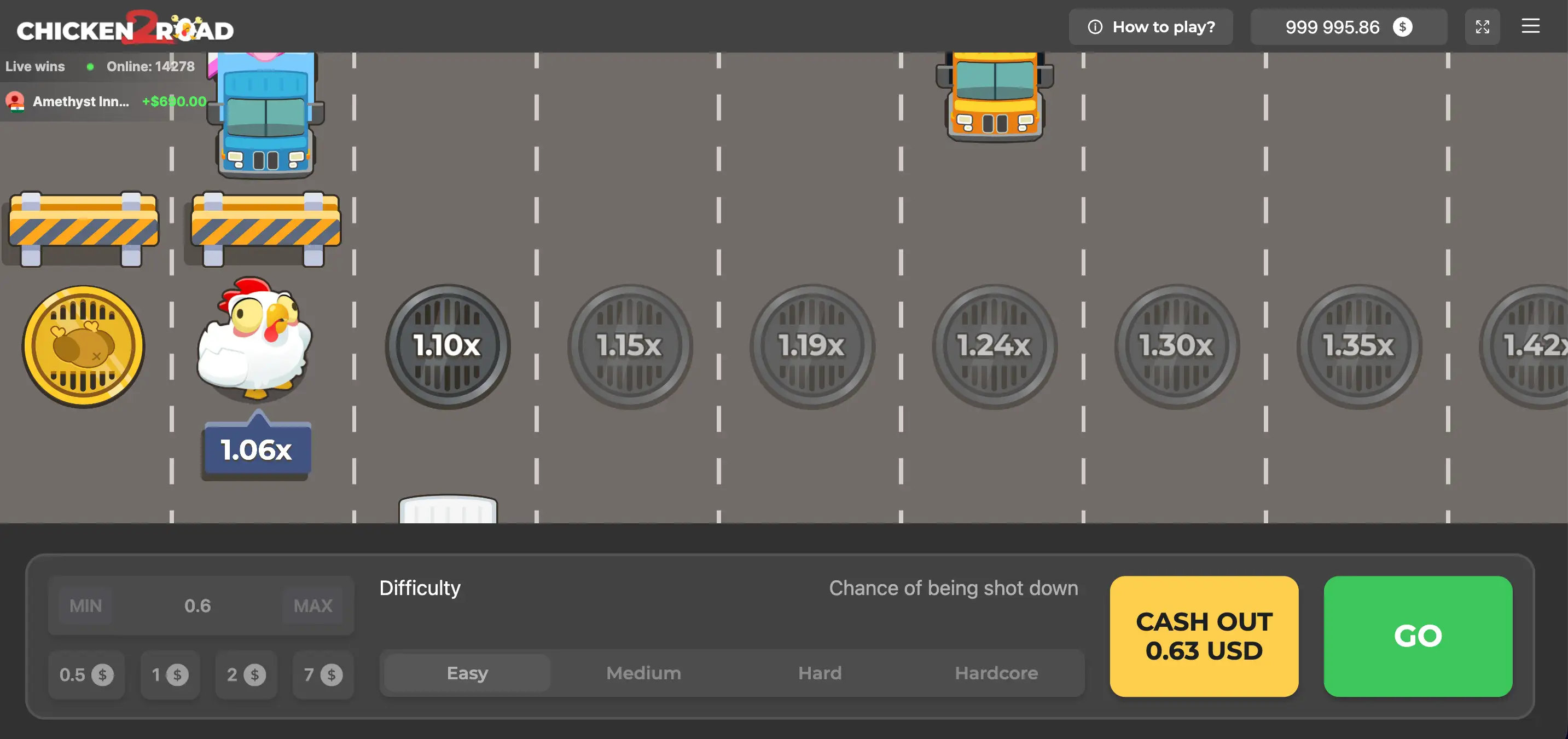
At first glance, Chicken Road 2 feels familiar: a chicken runs across a road, the multiplier climbs, and you must cash out before it gets hit. But beneath the surface, the sequel introduces several key mechanics that alter both strategy and volatility:
These changes don't eliminate the house edge—they simply redistribute risk across multiple decision points. As with all crash games, each round's outcome is determined by a provably fair RNG, and past results don't influence future ones. The "new" feel is mostly psychological: more player agency, more visual feedback, but the same underlying negative expected value.

Chicken Road 2 uses a tile-based crash model: the chicken steps onto a sequence of tiles, and each successful step increases the multiplier. Players can cash out after any safe step to lock in winnings. The crash point—which tile triggers the loss—is determined at the start of each round using a server seed, client seed, and nonce, all verifiable via the game's "Provably Fair" panel.
The sequel's difficulty system adds strategic depth. Once you select a mode (Easy, Medium, Hard, or Hardcore), the tile path and crash probabilities are fixed for that round:
Mathematically, the game's RTP ranges from 95.5% to 98% depending on mode and cash-out strategy. The house edge is 2–4.5%, aligning with industry standards for crash games. But RTP is a long-run average—short sessions can swing wildly. In practice, crash distribution follows these approximate patterns:
As noted in gambling math guides, "RTP ≠ promise, and every spin is independent." Chicken Road 2 is no exception. The new difficulty tiers and visual feedback don't change the core truth: this is a high-volatility game where rapid losses are common, especially in Hard and Hardcore modes.
Find a licensed operator that hosts Chicken Road 2 by InOut Games. Licensed platforms protect funds, apply KYC verification, and run the authentic build with provably fair verification.
Select a bet between $0.10 and $200 (or equivalent). Smaller stakes provide more attempts to learn timing and flow before risking larger amounts.
Choose Easy or Medium for longer runs and modest multipliers, or Hard/Hardcore for higher volatility and extreme payout potential. Your mode determines tile count, crash probability, and max multiplier.
The chicken steps onto the first tile. After each safe step, your multiplier increases. Watch visual cues (traffic patterns, animations) for risk signals.
After each successful step, you can cash out to lock the current multiplier, or continue for higher rewards. Cashing out secures bet × multiplier. Continuing increases both potential payout and risk.
The round concludes when you hit a trap (crash), reach the final tile (jackpot), or manually cash out. Wins are paid at bet × multiplier, subject to any casino currency cap (e.g., $20,000 max).
Because Chicken Road 2 is a high-volatility game, bankroll management isn't optional—it's essential. Here's a practical, risk-aware approach:
This aligns with responsible gambling principles emphasized in modern player guides: enable deposit limits, session timers, and reality checks in your account settings if available. Many licensed casinos allow you to set daily/weekly/monthly caps and self-exclusion periods.
Remember: Expected Value (EV) for Chicken Road 2 is negative. Almost all casino games have negative EV for the player—that's how the house makes money. Your goal isn't to "beat" the game, but to extend playtime, minimize emotional decisions, and treat gambling as entertainment, not income.
Chicken Road 2 uses a provably fair system, meaning you can verify each round's outcome using cryptographic hashes. Before the round starts, the server generates a seed, hashes it, and shares the hash with the player. After the round, the server reveals the seed, allowing you to confirm the result wasn't manipulated post-facto.
To verify a round:
However, fairness doesn't eliminate risk. The game is still designed with a built-in house edge of 2–4.5%. Playing on a licensed platform adds another layer of safety: regulators require that interrupted play be resumable, game states are preserved fairly, and RNG algorithms are audited by independent testing labs.
Chicken Road 2 is operated under a Curacao eGaming license. Always verify the operator's license status on the casino's footer or "About" page.
The game runs on HTML5 with SSL encryption for all data transmission. User funds and personal data are protected by industry-standard 256-bit encryption. Provably fair verification ensures RNG integrity for every round.
InOut Games uses certified RNG algorithms audited by independent testing labs. The provably fair system allows full transparency: server seeds are hashed before rounds, and outcomes can be verified post-game using cryptographic tools.
Licensed casinos hosting Chicken Road 2 typically offer deposit limits, session timers, self-exclusion options, and reality check reminders. Players must be 18+.
| Aspect | Chicken Road 2 | Aviator |
|---|---|---|
| Core Mechanic | Tile-based: guide chicken across traffic, cash out after each safe step | Multiplier climbs continuously; single cash-out decision before plane flies away |
| Player Control | Manual movement (forward + sideways), multiple cash-out points per round | One-tap cash out; can automate via auto cash-out feature |
| Round Duration | ~9–30 seconds depending on difficulty and skill | ~10–20 seconds |
| Feedback Style | Visual chaos: arcade-style animations, near-miss comedy, traffic patterns | Clean UI, number-led suspense, minimalist graphics |
| Risk Management Tools | Four difficulty modes, manual pacing, incremental cash-outs | Auto cash-out, split bets, live stats panel |
| RTP | 95.5–98% | ~97% |
| Best For | Players who prefer hands-on gameplay, arcade feel, and multiple decision points | Players who want clean, math-driven crash mechanics with automation and split-bet strategies |
Chicken Road 2 is a polished, engaging sequel that adds visual flair and strategic depth through its difficulty tiers—but it doesn't change the fundamental nature of crash games. It's fast, volatile, and designed for entertainment, not income.
If you enjoy high-risk, high-reward gameplay, value player agency over automation, and can stick to a strict budget, it's a valid option for occasional play. The provably fair system ensures transparency, and the adjustable difficulty lets you calibrate risk to your comfort level.
But if you're looking for consistent returns or a "system" to win, look elsewhere. No strategy can overcome the house edge over time. The game's 2–4.5% edge means long-term losses are mathematically inevitable for all players.
Chicken Road 2 introduces four difficulty modes (Easy, Medium, Hard, Hardcore) instead of a single path, level-based objectives with jackpot payouts, enhanced visual feedback with arcade-style animations, and dynamic volatility scaling. The original had a simpler endless-run format with fixed volatility.
RTP ranges from 95.5% to 98% depending on the difficulty mode and cash-out strategy. The house edge is 2–4.5%. This is competitive with other crash games like Aviator (~97% RTP).
Yes. Each round uses a server seed, client seed, and nonce determined before play begins. The server seed is hashed and shared with the player pre-round. After the round, the revealed seed can be verified using the in-game "Provably Fair" panel or third-party verification tools to confirm the outcome wasn't manipulated.
The theoretical maximum multiplier in Hardcore mode is 3,203,384.80x. However, most casinos cap payouts at a fixed currency amount (e.g., $20,000), so practical max win is limited by that ceiling regardless of multiplier achieved.
Easy or Medium for learning mechanics, extending playtime, and managing volatility. Hard or Hardcore for experienced players comfortable with rapid variance and seeking extreme multipliers. Match difficulty to your bankroll—never risk more than you can afford to lose.
Yes. Chicken Road 2 is built on HTML5 and runs in mobile and desktop browsers without download. The game is optimized for touch controls and responsive layout, ensuring smooth gameplay on smartphones and tablets.
No. Chicken Road 2 requires manual confirmation for every step. You actively guide the chicken forward and decide when to cash out after each safe tile. This contrasts with Aviator and other crash games that offer auto cash-out features.
The bet range is $0.10 to $200 (or currency equivalent). Exact limits may vary by casino. Always check the game interface for the specific min/max stakes available at your chosen operator.
Yes. Most casinos offer a free demo mode for Chicken Road 2. Demo play uses virtual credits and allows you to test mechanics, difficulty modes, and timing strategies without risking real money. Use demo mode to learn before playing for real stakes.
No. Chicken Road 2 has a built-in house edge of 2–4.5%, meaning long-term Expected Value (EV) is negative for all players. Pre-set cash-out targets and bankroll management can extend playtime and reduce emotional decisions, but no strategy can overcome the house edge over time. Treat the game as entertainment, not income.